
# LiDAR
日本語で読みたい方は、google chromeで開き、
画面上で右クリックをして、「日本語に翻訳」をクリックしてください
MSU forestry professor sabbatical connects Mexico, Italy and Michigan through forest innovation.
David MacFarlane, a professor of measurements and modeling in the Department of Forestry at Michigan State University, recently completed a six-month sabbatical that took him from the mangrove coasts of Mexico to the alpine forests of Italy. His journey was part of a Fulbright Global Scholar Award aimed at advancing an emerging global approach to forest management known as climate-smart forestry.
Climate-smart forestry integrates forest conservation, carbon storage and sustainable use of forest products to strengthen community resilience and combat climate change. For MacFarlane, the sabbatical was not only about research but also about building meaningful cross-cultural collaborations.
Reconnecting with the Field in Mexico
MacFarlane began his sabbatical in Mexico, where he had previously conducted research and leads an education abroad program. This time, he spent two months fully immersed — living in the community, setting up an office at a local institution and working closely with Mexican colleagues and students.
Two main themes guided his research in Mexico:
Mangrove Forests and Coastal Resilience
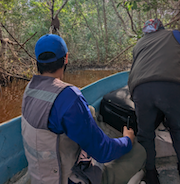
Working with Jorge Herrera and a team of students at CINVESTAV, MacFarlane explored how climate change is affecting coastal communities and mangrove ecosystems along the Gulf of Mexico. Using a terrestrial LiDAR laser scanner, he collected highly detailed 3D models of mangrove trees, including the red and black mangrove species in both old-growth and disturbed areas.
“It was the first time in a long while that I was collecting data myself,” he said. “It was invigorating — and gave me renewed appreciation for the students and technicians who support this work.”
These models allow researchers to study how mangrove structure influences carbon sequestration and storm resilience. For example, could certain mangrove structures better withstand hurricanes? Could we use this knowledge to help communities prepare for increasingly intense coastal storms?

Vanilla Agroforestry in the Maya Forest
In the Yucatán Peninsula, MacFarlane developed a conservation project aimed at reintroducing vanilla cultivation — a native understory orchid — into the Maya forest. The Maya Forest is the second-largest tropical rainforest in the Americas and spans Mexico, Guatemala and Belize.
By using LiDAR to analyze forest structure, MacFarlane and collaborator Javier Quezada-Euan are exploring how environmental conditions affect vanilla growth and pollination by native stingless bees, with a goal of helping local communities produce a high-value crop while preserving native forest ecology.
Additionally, he collaborated with city foresters in Mérida to scan large, historic urban trees — Mexico’s árboles patrimoniales, or “heritage trees.” This side project has already led to a new grant proposal for returning to scan more heritage trees in other Mexican cities.

Advancing Forestry Science in Italy
After two months in Mexico, MacFarlane spent four months in Italy, as a visiting professor with the Department of Land, Environment, Agriculture and Forestry at the University of Padova — one of the world’s oldest universities, founded in 1222.
Here, his work focused on the interaction between tree structure and wind resistance, tying directly into his overarching research theme. Italy had recently experienced the devastating “Vaia” windstorm, which caused extensive forest damage across the Alps.
MacFarlane scanned forests that survived the storm to analyze what structural characteristics made them more resilient. This work has implications for reforestation strategies across vulnerable alpine landscapes, which are vital for preventing avalanches and landslides.
He also taught a graduate course in English at the university, drawing students from Italy and many other countries. Teaching in a new environment and on a new topic reinvigorated his own learning. “It was like being a grad student again, diving deeply into new topics,” he reflected. “I learned new things I wouldn’t have studied otherwise.”

Bridging Urban Forestry, Botanical Gardens and Agroforestry
During his time in Italy, MacFarlane explored several innovative forestry applications:
- Urban Forestry: Collaborating with Francesco Petruzellis, he scanned historic trees in Padova’s Orto Botanico — the oldest university botanical garden in the world. The team is creating a virtual 3D botanical garden, integrating detailed scans with data on tree physiology and sensors for measuring the structural stability of the trees to wind.
- Agroforestry: On Italian farms, he studied hybrid poplar trees grown as an additional crop. These fast-growing trees are important in sustainable agriculture and MacFarlane’s scans will help determine how their structure affects resilience and productivity.
- Forest Simulation: Across all environments — coastal, urban, alpine and agricultural — his work uses scanning technology to model what happens if trees are pruned or removed. This type of virtual forestry could be critical for sustainable planning in an era of climate uncertainty.

A Global Perspective with Local Impact
MacFarlane’s sabbatical didn’t just expand the boundaries of his research — it helped bridge science, culture and geography. His collaborations in Mexico and Italy are now feeding back into his work in Michigan, bringing fresh perspectives to the study of climate-smart forestry.
The work is ongoing, with data still being processed and new metrics in development. But one thing is clear: the forests of the world — whether mangroves, mountain pines, or urban heritage trees — are deeply connected through both their environmental roles and the communities who depend on them.
This story originally appeared on the Department of Forestry website.

出典:
https://msutoday.msu.edu/news/2025/10/exploring-climate-smart-forestry-across-continents!--NoAds-->
ご参考:
(株)光響が提供する製品・サービス情報:
・LiDAR(バックパック型・超高点群密度・ソリッドステート)
In case of addition or removal of the article, please contact us as below:
info@symphotony.com
この情報へのアクセスはメンバーに限定されています。ログインしてください。メンバー登録は下記リンクをクリックしてください。
